
Information about reporting for 2025
The annual statutory reporting starts just after New Year and the register opens for report by 1 January 2026. Please note that there are certain dates and issues that you must remember or check. We have therefore established this page where you can find guidance and information during the entire reporting period.


Single-use plastics and tobacco filters
1 to 10 January 2026
1 to 10 April 2026
1 to 10 July 2026
1 to 10 October 2026


Reporting of electronics:
| Important dates for you to remember | What? | How? |
|---|---|---|
| 1 January to 31 March: Electronics | System opens for entry of figures | You must all report but if you are member of a collective scheme they will enter the figures on your behalf |
| 1 January: Annual reporting starts + Changes to previous year’s reporting | In addition to reporting from the previous year, all changes and corrections must be made in this period and no later than 31 March | Once logged in, please create a request for corrections |
| 31 March: Annual reporting for electronics ends | The system closes for reporting. | Reporting must be completed |
| 31 May: Authentication of reporting of electronics | Deadline for signature of management’s statement or auditor’s attestation for reporting of electronics | Login and select menu Auditor and management’s statements |
Reporting of batteries:
| Important dates for you to remember | What? | How? |
|---|---|---|
| 1 January to 31 March: Batteries | System opens for entry of figures | You must all report but if you are member of a collective scheme they will enter the figures on your behalf |
| 30 June: Annual reporting for batteries ends | The system closes for reporting. | Reporting must be completed |
Reporting of vehicles:
| Important dates for you to remember | What? | How? |
|---|---|---|
| 1 January to 30 June: Vehicles | Data on imported vehicles | You must all report but if you are member of a collective scheme they will enter the figures on your behalf |
| 31 March: Annual reporting for vehicles ends | The system closes for reporting. | Reporting must be completed |
Reporting of packaging:
| Important dates for you to remember | What? | How? |
|---|---|---|
| 1 January to 31 May: Packaging | System opens for entry of figures | You must all report but if you are member of a collective scheme they will enter the figures on your behalf |
| 31 May: Annual reporting for packaging ends | The system closes for reporting. | Reporting must be completed |
Reporting of single-use plastic and tobacco filters:
| Important dates for you to remember | What? | How? |
|---|---|---|
| 1 January to 10 January: Single-use plastics and tobacco filters | System opens for entry of figures for the 4st quarter 2025 | You must all report but if you are member of a collective scheme they will enter the figures on your behalf |
| 10 January: The 4st quarter 2025 reporting for single-use plastics and tobacco filters ends | The system will close for reporting. | The report must be completed |
| 1 April to 10 April: Single-use plastics and tobacco filters | System opens for entry of figures for the 1st quarter | You must all report but if you are member of a collective scheme they will enter the figures on your behalf |
| 10 April: The 1st quarter reporting for single-use plastics and tobacco filters ends | The system will close for reporting. | The report must be completed |
| 1 July to 10 July: Single-use plastics and tobacco filters | System opens for entry of figures for the 2nd quarter | You must all report but if you are member of a collective scheme they will enter the figures on your behalf. |
| 10 July: The 2nd quarter reporting for single-use plastics and tobacco filters ends | The system will close for reporting. | The report must be completed |
| 1 October to 10 October: Single-use plastics and tobacco filters | System opens for entry of figures for the 3rd quarter | You must all report but if you are member of a collective scheme they will enter the figures on your behalf. |
| 10 July: The 3rd quarter reporting for single-use plastics and tobacco filters ends | The system will close for reporting. | The report must be completed |
Reporting of fishing gear:
| Important dates for you to remember | What? | How? |
|---|---|---|
| 1 January to 31 March: Fishing gear | System opens for entry of figures | You must all report but if you are member of a collective scheme like they will enter the figures on your behalf |
| 31 March: Annual reporting for fishing gear ends | The system closes for reporting. | Reporting must be completed |
Reporting of End-of-life vehicles:
| Important dates for you to remember | What? | How? |
|---|---|---|
| 15 January: End-of-life vehicles | Car breakers’ reporting of environmentally treated scrap-vehicles starts | Reporting can be done up to 15 April |
| 15 April: End-of-life vehicles | Car breakers’ reporting of environmentally treated scrap-vehicles ends | Reporting must be completed and approved |
Producer Responsibility Register
The national producer responsibility register for products covered by producer responsibility in Denmark. This is where you, as a producer or importer, must be registered in order to legally market your products in Denmark. Each EU country has a similar national register, to which businesses report annually the quantities of products that have been sold, collected, and environmentally treated in that country.
Questions and answers about reporting (FAQ)
The reporting period is every year from 1 January. In this period, you will report as a producer/importer all you have sold on the Danish market in the previous calendar year.
You can yourself select and deselect categories, so it fits with your range of products. The years are shown in the tabs on the page. The year open for reporting is the previous calendar year.
On this page, you can see how to access our register:
If your company is affiliated to a compliance schemes, they will transfer data on your behalf. Thereby, you must NOT report yourself to DPA on electronics, industrial and automotive batteries:
BUT!
Some businesses choose to assume their producer responsibility themselves and are thereby in whole or in part (only for certain categories) not members of a compliance scheme. They are called individual compliers.
- If you are an individual complier OR has product categories, e.g. professional products that are not affiliated to a compliance scheme, you must report directly in the register.
- Portable batteries must always be reported by yourselves through SKAT and your business file there. Read more here
- The reporting declaration must be signed by the business itself, irrespective of membership of a compliance scheme
You can change your report throughout the entire reporting period – from 1 January to 31 March. Contact your compliance scheme or your authorised representative if you disagree with the data transferred or make the corrections yourselves if you have typos.
It is not possible to make changes after 31 March.
Request for corrections: Changes to previous year’s reporting.
If the reporting period has ended you can create a request for corrections in the next reporting period and then change the quantities that have been reported incorrectly.
A feature has been developed so that you can open up for corrections to the last report without the involvement of DPA.
If your auditor or your bookkeeper has found that there are errors in your report, you can log in and sign a request for corrections; then the system opens the previous report, and you can make your corrections.
Compliance scheme or Authorised representative (AR)?
If you are a member of a compliance scheme or you have an AR, they must make the corrections on your behalf. In practice it is done as follows: when you have signed the request for corrections the compliance scheme or your AR will be notified that you have changes to the report, and they are asked to enter the correct quantity.
What’s the cost? Is it a tax?
Producer responsibility has certain implications, both in the form of costs and revenues. Overall, these are a one-off fee for registration and an annual quantity-based fee related to quantities placed on the Danish market in a calendar year. In addition, membership of a collective scheme also entails some costs.
However, there is only one statutory fee (and one that only applies to portable batteries and SKAT). Fee rates are calculated by DPA based on annual reporting of quantities, and they are approved by the Minister for the Environment. The fee rates are published annually on the DPA website.
Since there is often a positive value of the resources recovered in the environmental treatment of waste electronics, batteries, and vehicles, there may be fine revenues if the duty of take-back and treatment is organised in a smooth way.
You can calculate your statutory costs in our online calculator, where you can enter the expected annual quantities placed on the market and see what you should expect to pay for your registration and administration of the reporting system.
Annual reporting for electronics must be completed.
- First and foremost, make sure that you or your compliance scheme has completed the annual reporting.
- When you are logged onto the producer register you must choose the menu item “Statements”.
- Answer the questions here and find out whether you have to make an Auditor’s attestation or a Management’s statement.
- If you need to make an auditor’s attestation you must invite your auditor:
- Fill in the CVR number of the audit firm, name and e-mail of the auditor, and send the e-mail.
- Now the auditor can accept and thereby get access to those of your data that he/she needs.
On this page, you can see how to access our register:

Inactivation
Non-reporting leads to inactivation
Please note that your business will be inactivated in the producer register if the reporting is not completed in due time and further to the directions of DPA. Inactivation means, among others, that your business can no longer legally deal in in-scope products in Denmark. If you wish to re-register, DPA must be contacted, and you must complete your reporting and pay a new registration fee.
Log in and reportReporting of quantities applies to products placed on the market in Denmark in 2025
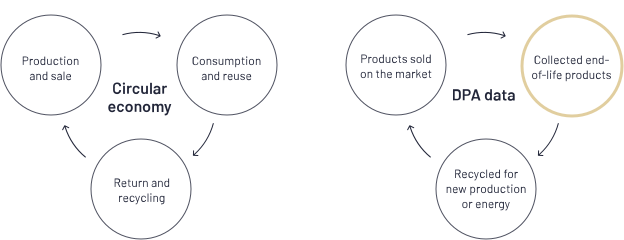
In addition to the quantity sold in kg, you should, for your own sake, also report the quantities of products covered by producer responsibility that you have taken back or received as used, defective or obsolete products, as these quantities are set off against your take-back obligation
Furthermore you must report quantities in kilograms of end-of-life products sent to environmental treatment with approved recycling facilities.
New minimum requirements and environmental target achievement
When you report all the required quantities, the reporting system calculates your recycling and recovery percentages. You will find the calculation in your company’s Annual Report when you are logged in.
Definition of quantity

Electronics
Kilograms
The weight is stated and reported in kilograms, as the weight of the entire product (finished article) in the form it is sold to the end-user, including electronic accessories but excluding batteries and accumulators, packaging, and manuals.
Seven reporting categories
Batteries
Kilograms
The weight is always stated in entire kilograms, as the weight of the entire product (finished article) in the form it is sold to the purchaser, but excluding the weight of transport packaging, instructions and manuals. If the battery is incorporated into an appliance only the weight of the battery is stated. For batteries containing liquids (electrolyte) the weight is stated including liquid.
Portable batteries are reported to SKAT
Vehicles
Units
Vehicles sold are stated in number of passenger vehicles (M1) or small trucks (N1). Vehicles to be registered in the producer register with DPA are new vehicles and second-hand foreign vehicles imported and registered for use in Denmark for the first time. In practice, DPA receives from the Motor Vehicle Agency information about the number of vehicles imported and registered by Danish businesses in a calendar year.
Data from the Motor Vehicle Agency
Packaging
Kilograms
The weight is always calculated and reported in kg, representing the weight of the packaging made available on the Danish market.

Single-use plastics
Kilograms
Most quantities must be reported in kg. However, wet wipes, balloons, and tobacco filters must be reported in units.

Register
Producer register
We are operating the national producer register for electronics, vehicles, and batteries. If you are a producer or an importer of in-scope products, this is where you must register to legally place your products on the market in Denmark. In every EU country there is a similar national register where businesses report every year how many products have been sold, collected, and environmentally treated in that country.
Log in with MitID ErhvervShortcuts
Guidelines for Registration and Annual Reporting
Step-by-step document : Guidelines for registration and reporting 2024.
About registration
See how to register as a new producer in the producer register
See registered producers
See registered producers and importers of electronics, batteries, and vehicles
Compliance schemes
See information about collective vs individual compliance schemes and authorised representatives
Other players
See which other players in addition to producers, importers, and authorities are involved in the producer responsibility with various roles
Annual reporting
Read more about annual reporting of electronics
Economy and fees
See current fees for products subject to producer responsibility
Legislation relating to electronics
See the statutory basis for producer responsibility for electronics
Exemptions
See which types of electrical equipment are subject to exemptions
Marking of equipment
Read more about requirements for marking of electronics
Management of waste electronics and batteries
Read more about how to collect and manage waste electronics and end-of-life batteries